Head in the ScriptsStart studying
Words · Grammar · Context

Bible Word Study Tools for Deeper Scripture Study

A good Bible word study does more than look up a definition.

Head in the Scripts helps you examine the words behind the English text through Greek and Hebrew lemmas, grammatical information, dictionary data, and occurrences throughout Scripture—all without moving between a pile of disconnected resources.

Study the word. See where it occurs. Examine its form. Read every passage in context.

Free to study. No account required.

Go Beyond the English Word

English Bible translations faithfully communicate Scripture, but every translation involves decisions.

Sometimes a closer look at the underlying Greek or Hebrew can help you understand why a passage is translated the way it is, how a word functions grammatically, where else the biblical authors use it, and how its meaning changes depending on context.

Head in the Scripts brings these Bible word study tools together inside the same Scripture-centered workspace.

Instead of treating a dictionary definition as the final answer, you can investigate the actual biblical word and work outward from the text.

Study Biblical Words More Carefully

Find the Original Word

Move from the English text to the underlying Greek or Hebrew word so you can see what stands behind the translation. A single English word may represent several different original-language words—and one Greek or Hebrew word may be translated differently depending on context.

Understand How the Word Functions

See grammatical and morphological information connected to a word rather than treating vocabulary as isolated definitions. Knowing whether a word is a noun, verb, participle, imperative, plural, singular, or another grammatical form can materially affect how you understand its function in the sentence.

Trace the Word Through Scripture

Explore other places where the same original-language word occurs and open those passages in context. This gives you something much more useful than a list of English-word matches: a way to investigate how the biblical writers actually use the same lemma throughout Scripture.

Bible Word Study Tools Built Around the Text

Lemma Identification

A lemma is the dictionary form of a biblical word. Because Greek and Hebrew words change form depending on grammar, identifying the lemma helps connect an inflected word in a passage with its underlying lexical entry. Head in the Scripts lets you move from the word as it appears in the verse to the underlying lemma so you can study the word more accurately.

Explore lemmas →

Greek Word Study Tools

Study New Testament Greek without needing to leave the passage you are reading. Use the Greek word study tool to examine the original word, its lemma, grammatical information, dictionary data, and occurrences elsewhere in the New Testament. This can be useful for sermon preparation, Greek coursework, exegetical papers, Bible studies, personal study, and examining translation decisions.

Explore Greek Bible study →

Hebrew Word Study Tools

Move behind an Old Testament translation and investigate the underlying Hebrew vocabulary. The Hebrew word study tool helps you examine Hebrew lemmas, grammatical information, word meanings, and other passages where the word occurs. Rather than asking only, “What does this Hebrew word mean?” you can begin asking a better question: How is this word actually being used here?

Explore Hebrew Bible study →

Grammar and Morphology

Words do not exist by themselves. They function inside sentences. Morphology identifies the grammatical form of a word, helping you understand information such as person, number, tense, voice, mood, case, gender, and other grammatical categories when applicable. That information helps keep a biblical word study connected to grammar instead of reducing interpretation to dictionary definitions.

Explore Bible morphology tools →

Bible Lexicon and Dictionary Information

Quickly access lexical and dictionary information while investigating a biblical word. Lexicons are useful, but they should be the beginning of investigation rather than the end of it. A definition provides possibilities. The passage determines meaning. Head in the Scripts keeps lexical information close to the biblical text so you can examine the definition alongside grammar and context.

Explore Bible lexicon tools →

Word Occurrences Throughout Scripture

One of the most valuable parts of a Bible word study online is the ability to see where the same original-language word occurs elsewhere. Head in the Scripts lets you investigate occurrences and move directly into the surrounding passages. Where else does this lemma occur? How does the author use it elsewhere? Does the meaning remain consistent? Does the context change its nuance? Is this usage common or unusual? That kind of investigation is far more useful than assuming one English definition applies everywhere.

Explore word occurrences →

A Better Way to Do Bible Word Studies

Word studies can become misleading surprisingly quickly. Someone finds a Greek or Hebrew definition, chooses the meaning they like best, and inserts it into a verse regardless of context.

That is not careful exegesis.

A responsible word study considers:

Lemma
What underlying word is actually present?
Morphology
What grammatical form appears in this passage?
Lexical Range
What meanings can this word legitimately carry?
Biblical Usage
How is the word used elsewhere?
Immediate Context
What does the sentence, paragraph, and argument require here?
Authorial Usage
How does this biblical writer typically use the word?

The goal is not to find a hidden meaning behind the English Bible. The goal is to understand the biblical text more carefully.

From One Word to the Whole Passage

A word can matter enormously. But Scripture is not a collection of isolated vocabulary terms.

That is why Head in the Scripts is designed around an integrated study workflow. You can move from:

Scripture → Original Word → Lemma → Grammar → Definition → Occurrences → Context → Commentary

without turning your study into twenty browser tabs. The tools stay connected to the text because the text should remain the center of the study.

Bible Word Study for Pastors

Pastors regularly encounter words that deserve additional investigation during sermon preparation.

A Bible word study for preaching can help determine whether an important theological term carries a particular nuance, whether an English translation reflects an unusual grammatical construction, or whether a repeated word contributes to an author’s argument.

Head in the Scripts allows pastors to move quickly from the passage into Greek or Hebrew research and then back into the broader context.

The objective is not to fill sermons with Greek and Hebrew terminology. It is to help pastors understand the passage well enough to preach it faithfully.

Bible Word Study for Seminary Students

Seminary and Bible college assignments frequently require more than identifying a Strong’s number or copying a lexicon definition.

Students may need to examine:

  • The original lemma
  • Grammatical form
  • Semantic range
  • Occurrences
  • Contextual usage
  • Translation choices
  • Exegetical significance

Head in the Scripts is designed to make that research easier to access while keeping the student responsible for interpretation. The software provides the information. You still have to read, compare, reason, and exegete.

Why Use Head in the Scripts for Bible Word Study?

Scripture Stays at the Center

Word-study tools should serve Scripture rather than distract from it. You begin with the passage and move deeper from there.

Original-Language Information in One Workspace

Study lemmas, morphology, definitions, occurrences, original-language text, English Scripture, and supporting resources without constantly switching platforms.

Built for Serious Study Without Unnecessary Complexity

Head in the Scripts is intended to bridge the gap between a basic Bible reader and complicated professional Bible software. You get access to meaningful original-language research without needing an enormous software ecosystem simply to investigate a word.

Useful Whether You Know Greek and Hebrew or Not

Language students can inspect grammatical information directly. Pastors and serious Bible readers without formal language training can still examine underlying words while learning what the information actually means.

Free Access

Head in the Scripts is built around the conviction that serious biblical study should be more accessible. The core platform is free to use, and you can begin studying without creating an account.

How to Do a Bible Word Study with Head in the Scripts

Step 1

Choose a Passage

Begin with Scripture. Read the surrounding paragraph before isolating individual words.

Step 2

Select the Word You Want to Investigate

Open the original-language information connected to the word in your passage.

Step 3

Identify the Lemma

Determine the underlying Greek or Hebrew dictionary form.

Step 4

Examine the Grammar

Look at the morphological information and determine how the word functions in the sentence.

Step 5

Review Lexical Information

Consider the possible meanings of the word without automatically assuming every definition applies to your passage.

Step 6

Explore Other Occurrences

See where the same lemma appears elsewhere in Scripture and read those passages in context.

Step 7

Return to the Passage

Bring everything back to the verse, paragraph, book, author, and broader biblical context. That final step matters. Word-study tools provide evidence. Context determines interpretation.

Bible Word Study Example

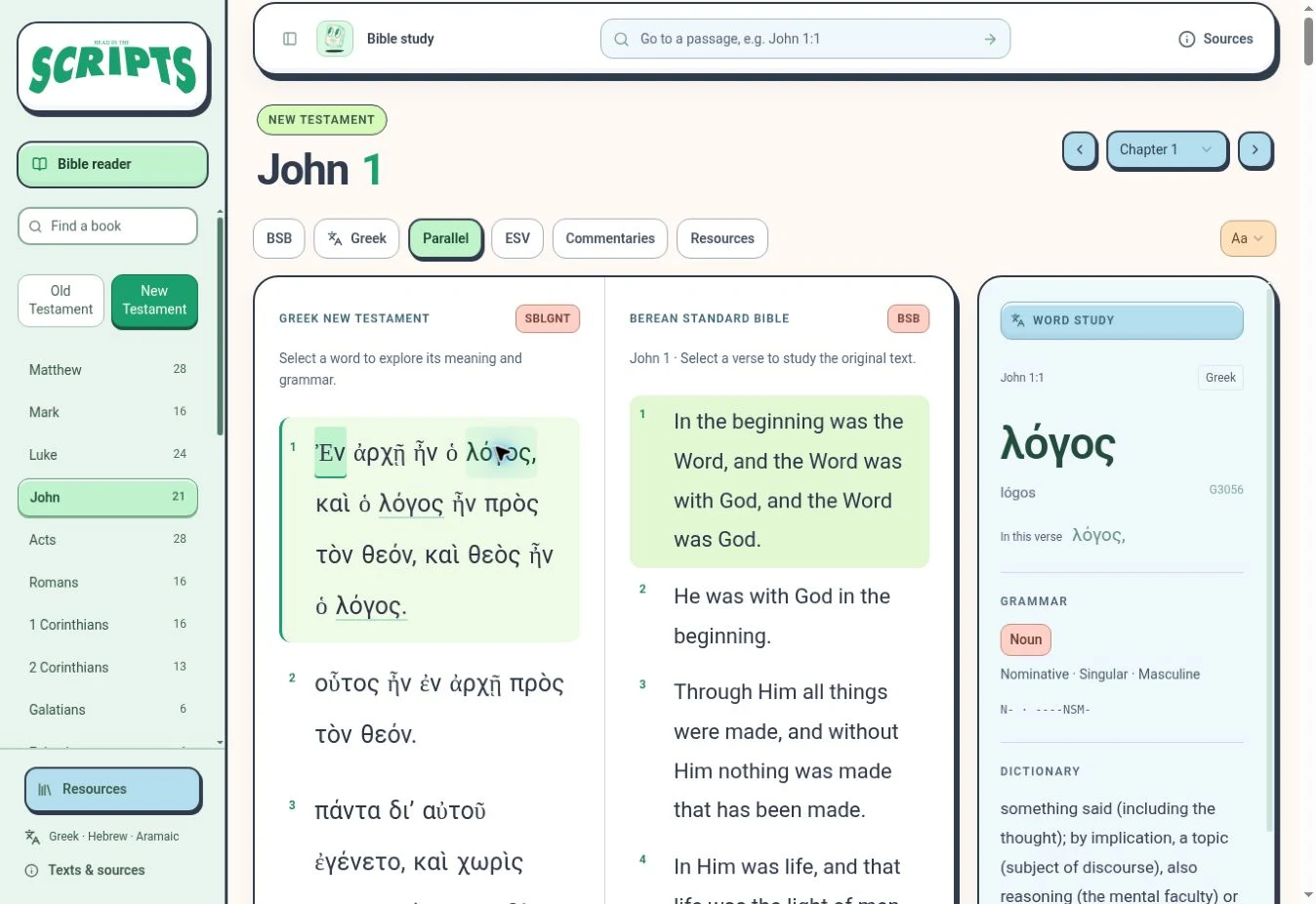
Consider the Greek word λόγος — logos in John 1:1.

A basic lookup might tell you that logos can refer to a word, message, statement, account, or other related ideas. But simply collecting possible definitions does not explain John 1:1.

A stronger word study would ask:

  • What is the lemma?
  • What grammatical form appears here?
  • Where else does John use this word?
  • How does John develop the concept through the opening verses?
  • How does the immediate context identify “the Word”?
  • How does the broader Gospel contribute to the meaning?

The purpose of a Greek word study tool is therefore not to replace interpretation. It gives you better evidence with which to interpret.

Open John 1:1 and select λόγος
Greek word study in John 1 showing logos, its lemma, noun morphology, and dictionary information beside Scripture
The live workspace with λόγος selected. Begin with John 1:1, then investigate the word in its context.

Word Studies Without the Usual Friction

Serious biblical study often means moving among a Bible reader, an interlinear, a concordance, a lexicon, morphology tools, commentaries, and additional research resources.

Each tool may be useful. The friction comes from constantly moving between them.

Head in the Scripts is being built to reduce that friction.

Read the passage. Investigate the word. Check the grammar. Trace its occurrences. Compare the context. Continue studying.

All while Scripture remains in front of you.

Related Bible Study Tools

Frequently Asked Questions About Bible Word Study

What is a Bible word study?

A Bible word study is the process of investigating an important word in Scripture by examining the underlying Greek or Hebrew word, its lemma, grammatical form, possible meanings, occurrences elsewhere in Scripture, and usage within its immediate context. A responsible word study does not simply choose a dictionary definition and insert it into the verse. Meaning must be determined from grammar and context.

Can I do a Bible word study without knowing Greek or Hebrew?

Yes. You do not need to be fluent in biblical Greek or Hebrew to begin examining original-language information. Tools can help you identify lemmas, definitions, grammatical forms, and occurrences. However, users without language training should be especially careful not to draw conclusions from vocabulary alone. Context and grammar still matter.

Is Head in the Scripts a free Bible word study tool?

Yes. Head in the Scripts currently provides free access to its Bible study platform, and an account is not required to begin studying.

Can I study both Greek and Hebrew Bible words?

Yes. Head in the Scripts includes tools for studying original-language material from both the New Testament and Old Testament, including Greek and Hebrew word information. Aramaic study resources are also part of the broader original-language platform.

What is a lemma in a Bible word study?

A lemma is the standard dictionary form of a word. Biblical Greek and Hebrew words can appear in many different grammatical forms. Identifying the lemma connects the form appearing in the biblical passage to the underlying word used for lexical research and occurrence searches.

Why is morphology important in a Bible word study?

Morphology tells you about the grammatical form of a word. Depending on the language and word, this can include information such as tense, voice, mood, person, number, gender, case, or other grammatical categories. A word’s grammatical form can materially affect how it functions within the sentence.

Is a Bible word study the same as using Strong’s Concordance?

Not exactly. Strong’s numbers can be useful for connecting English words with original-language entries, but a full word study should normally go further. It should consider the original lemma, morphology, lexical range, biblical occurrences, immediate context, and the way the author uses the word.

How should pastors use Bible word studies in sermon preparation?

Pastors can use word studies to investigate significant terms, grammatical questions, repeated vocabulary, translation differences, or words that contribute to the argument of a passage. The goal should not be to impress a congregation with Greek or Hebrew terminology. The goal is better exegesis that contributes to clearer and more faithful preaching.

What is the biggest mistake people make in Bible word studies?

One of the biggest mistakes is assuming that every possible dictionary definition of a word is present every time that word appears. Words have semantic ranges, and context determines which meaning is appropriate in a particular passage. Another common mistake is ignoring grammar and treating words as though they exist independently from sentences.

Study the Word Without Losing the Text

Going deeper into Scripture does not mean searching for secret meanings. It means becoming more careful with what is actually there.

Study the Greek. Study the Hebrew. Examine the lemma. Consider the grammar. Trace the occurrences. Then return to the passage.

Head in the Scripts gives you the tools to investigate biblical words while keeping Scripture where it belongs: at the center of the study.

Free tools. Deeper study. No account required.