Head in the ScriptsStart studying
English + Greek + Hebrew

Free Interlinear Bible for Greek & Hebrew Bible Study

Study Scripture alongside the biblical languages without constantly jumping between separate websites, dictionaries, concordances, and study tools.

Head in the Scripts brings the biblical text together with Greek and Hebrew study tools, original-language lemmas, grammar and morphology, dictionary information, word occurrences, and parallel study in one connected workspace.

Free to study. No account required.

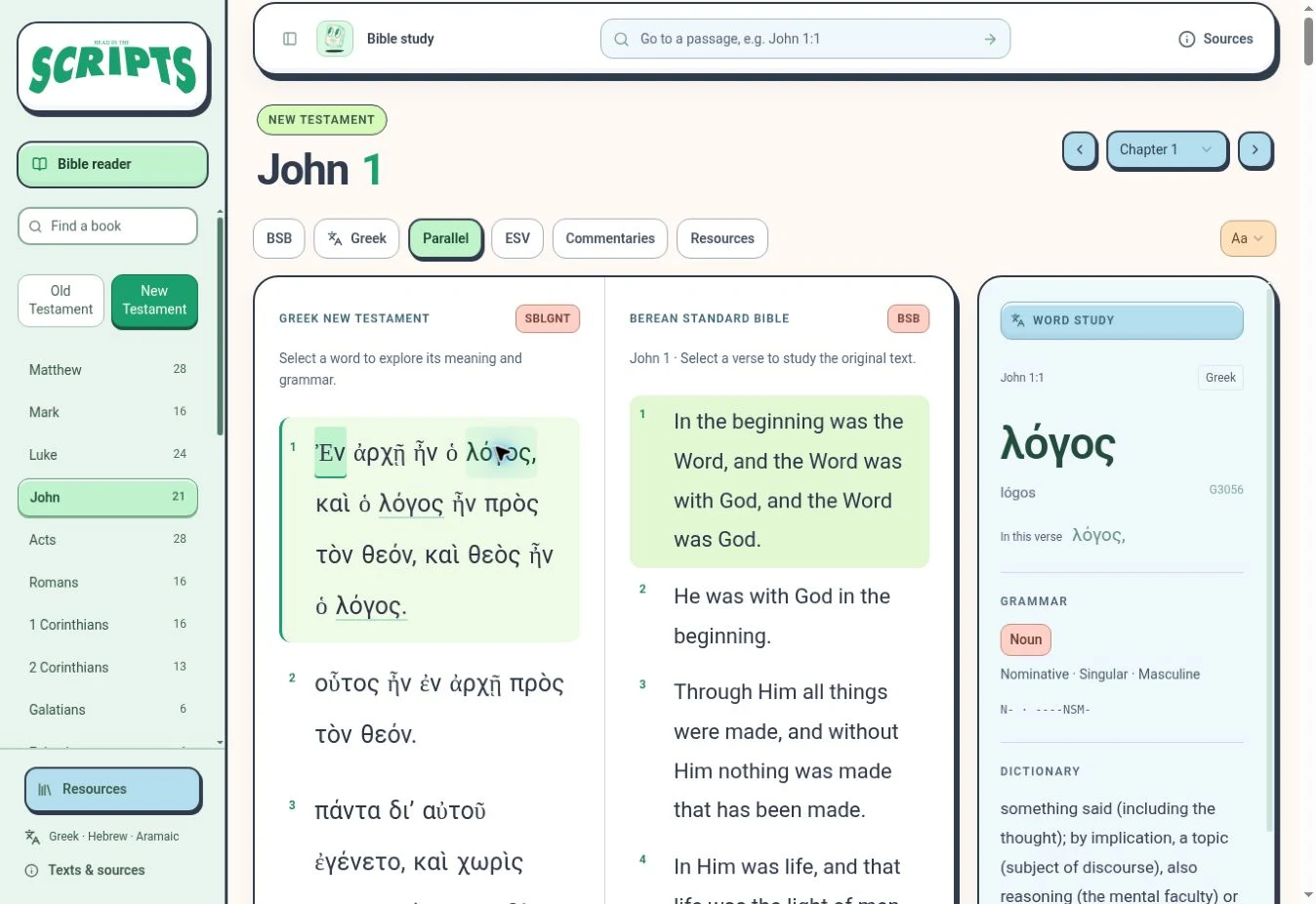
John 1 in Head in the Scripts with Greek and English Scripture side by side and logos lemma, grammar, and dictionary information
John 1 in the live study workspace. Read Greek and English together, then select a word to explore its meaning and grammar.

Go Beneath the English Translation Without Losing Sight of the Text

An interlinear Bible helps you examine the original language behind an English Bible passage while keeping the biblical text in view.

Instead of treating Greek or Hebrew words as isolated dictionary entries, Head in the Scripts is designed to help you examine them within the larger passage. Select a word, inspect its lemma and grammatical information, explore dictionary information, find other occurrences, and continue reading Scripture in context.

The point is not to make the Bible more complicated. It is to make serious study more accessible.

A Better Way to Study the Biblical Languages

See English and the Original Language Together

Keep the biblical passage at the center while working with its underlying Greek or Hebrew text. Parallel study makes it easier to move between the English Bible and the biblical languages without losing your place or disconnecting a word from its surrounding passage.

Understand More Than a Translation

English translations necessarily make interpretive choices. Original-language study lets you look more closely at the words underneath those translations so you can ask better questions about vocabulary, grammar, and usage.

Study Without Building an Expensive Software Library

Head in the Scripts is designed to make serious biblical research more accessible. Use the interlinear and original-language study tools online for free and begin studying without creating an account.

What You Can Study With the Interlinear Bible

Greek Interlinear Bible Study

Study New Testament passages with access to the underlying Greek text and word-level information. Select words to investigate their lemma, grammatical form, dictionary information, and occurrences elsewhere in Scripture. Whether you are learning Biblical Greek or returning to it during sermon preparation, the goal is to help you work with the language while keeping the biblical passage in front of you.

Explore Greek study →

Hebrew Interlinear Bible Study

Work through Old Testament passages while comparing the English text with Biblical Hebrew. Explore individual words, grammatical information, dictionary data, and usage across Scripture without separating the language work from the passage you are actually studying.

Explore Hebrew tools →

Lemmas

The form of a word that appears in a verse is not always the form you would find in a dictionary. A lemma identifies the base or dictionary form of the original-language word. Seeing the lemma helps connect an inflected form in the biblical text with lexical information and other occurrences of the same underlying word.

Explore Bible word study →

Grammar & Morphology

Knowing a dictionary definition is not enough to understand how a word functions in a sentence. Morphological information helps identify grammatical features of Greek and Hebrew words so you can study how a particular form is functioning in its context. A dictionary definition does not equal meaning in every passage. Context and grammar still matter.

Explore morphology tools →

Dictionary Information

Move from the biblical word to useful dictionary information without abandoning your passage. Lexical information can help you begin understanding the possible range and background of a word, while the surrounding verse and broader biblical context help determine how that word is actually functioning.

Explore Bible lexicon tools →

Word Occurrences Across Scripture

Find other passages where an original-language word occurs and open those passages in context. This helps you move beyond a single English rendering and investigate how the underlying Greek or Hebrew word is used elsewhere. That makes the interlinear Bible useful not merely for translation comparison, but for deeper Bible word study.

Use Bible word study tools →

Parallel Bible Study

Sometimes you do not need another window. You need the biblical texts you are comparing to stay visible together. Parallel study keeps English and original-language Scripture within the same research workflow so you can move through a passage naturally.

Explore parallel Bible study →

An Interlinear Bible Should Help You Read Scripture More Carefully

Original-language tools are powerful. They can also be misused.

Looking up a Greek or Hebrew word does not automatically settle the interpretation of a verse. A word can carry several possible senses, and grammatical form, sentence structure, literary context, historical context, and the larger biblical argument still matter.

Head in the Scripts is built around a simple principle:

The tools should serve Scripture rather than replace careful reading of Scripture.

Use the interlinear to ask better questions—not to bypass exegesis.

Who Is the Interlinear Bible For?

Seminary Students

Keep Greek and Hebrew work connected to the biblical text while working through language courses, exegetical assignments, papers, and passage studies. Move between Scripture, word information, morphology, occurrences, and related study resources without rebuilding your research workflow for every assignment.

Pastors

Use the interlinear Bible during sermon preparation to examine significant words, investigate grammatical forms, trace word usage, and work more carefully with the underlying text. The purpose is not to fill sermons with Greek and Hebrew terminology. It is to help pastors understand the passage more faithfully before teaching it.

Bible College Students

Develop familiarity with original-language Bible study while working through class assignments, biblical interpretation, theology courses, and passage research.

Serious Bible Readers

You do not have to be a Greek or Hebrew scholar to begin learning what lies beneath an English translation. Technical information should help you grow as a reader of Scripture—not create another barrier between you and the text.

How to Use the Interlinear Bible

Step 1

Choose a Passage

Begin with Scripture. Open the book, chapter, or passage you want to study before reaching for secondary resources.

Step 2

Read the Passage in Context

Read the surrounding verses first. Before investigating individual words, understand the basic argument, narrative, or thought of the passage.

Step 3

Compare the Original Language

View the English and original-language text together and identify words or grammatical features worth examining more closely.

Step 4

Select a Word

Open its available original-language information, including the lemma, grammatical form, and dictionary information.

Step 5

Examine Other Occurrences

Look at other passages where the underlying word appears. Do not merely count occurrences—read those passages in context.

Step 6

Return to the Passage

Bring what you have learned back into the verse, paragraph, chapter, and biblical book you started with. The goal of language study is not collecting interesting Greek and Hebrew facts. The goal is understanding Scripture better.

Why Use Head in the Scripts for Interlinear Bible Study?

There are already excellent Bible resources online. Head in the Scripts is not trying to win by placing the largest possible library in front of you. It is being built around a different goal:

Make serious Bible study unusually accessible.

Scripture Comes First

The study experience begins with the biblical text rather than a commentary, generated answer, or theological conclusion.

Original-Language Tools Stay Connected

Greek and Hebrew study, lemmas, grammatical information, word occurrences, and related resources belong inside the same study process.

Built for Serious Study

The platform is being developed with pastors, seminary students, Bible college students, church leaders, and serious students of Scripture in mind.

Free Access

Use the Bible study platform without paying for the core tools.

No Account Required

You can begin studying without creating an account.

Continually Improving

Head in the Scripts is an actively developed platform designed around the real study needs of pastors and theological students.

Interlinear Bible vs. Simply Looking Up Greek and Hebrew Words

There is an important difference between studying an original-language word and merely finding an English definition.

A responsible study asks questions such as:

  • What original word appears here?
  • What is its lemma?
  • What grammatical form appears in this verse?
  • How is the word functioning in this sentence?
  • Where else does the word occur?
  • How is it used in those passages?
  • What does the surrounding context suggest?
  • How does the author’s argument shape its meaning?

That is why Head in the Scripts connects word-level information back to Scripture. The original languages are not a shortcut around context. They are another way of paying closer attention to it.

From Interlinear Bible to Deeper Bible Study

An interlinear is often only the beginning of a passage study. From the text you can continue into:

Frequently Asked Questions About Interlinear Bibles

What is an interlinear Bible?

An interlinear Bible displays or connects the biblical text with its underlying original language so readers can examine the Greek or Hebrew associated with a passage. It can help students investigate original-language vocabulary, grammatical information, lemmas, and translation choices while keeping the biblical text in view.

Is the Head in the Scripts interlinear Bible free?

Yes. Head in the Scripts currently provides free access to its Bible study tools, and you can begin studying without creating an account.

Does the interlinear Bible include Greek and Hebrew?

Head in the Scripts provides tools for studying both Biblical Greek and Biblical Hebrew. The broader platform also includes Aramaic study resources.

Can beginners use an interlinear Bible?

Yes, but beginners should use an interlinear carefully. You do not need to be fluent in Greek or Hebrew to benefit from seeing original-language information. However, a dictionary definition alone does not determine what a biblical word means in every passage. Grammar and context still matter.

Is an interlinear Bible useful for pastors?

Yes. An interlinear Bible can support sermon preparation by helping pastors examine important words, grammatical forms, and original-language usage. It should support exegesis rather than replace it.

Is an interlinear Bible useful for seminary students?

Yes. Seminary students can use interlinear tools while studying Biblical Greek or Hebrew, completing exegetical assignments, researching passages, and preparing papers.

What is the difference between an interlinear Bible and a lexicon?

An interlinear connects original-language information to a biblical passage. A lexicon provides information about words themselves. They work best together: identify the relevant word in the passage, examine its lemma and grammatical form, then consult lexical information while continuing to evaluate the immediate context.

Can I use an interlinear Bible without knowing Greek or Hebrew?

Yes. An interlinear Bible can help you begin recognizing the original language behind an English translation even if you have not received formal language training. The important thing is to treat language tools as aids to careful interpretation rather than shortcuts to certainty.

Study the Bible Beneath the Translation

English Bible translations give Christians extraordinary access to Scripture. Original-language study lets you look more closely at the words, forms, and structures behind those translations.

Head in the Scripts brings those tools into a study environment designed to keep Scripture at the center.

Free tools. Deeper study.